kmzorthoman@gmail.com

Move Better With Expert Care

KMZ Orthoman Frozen Shoulder Care

Frozen Shoulder Treatment in Kuala Lumpur

Get orthopaedic assessment and treatment guidance for frozen shoulder, shoulder pain, stiffness and limited movement. Dr KMZ provides patient-friendly care based on symptoms, shoulder movement, clinical assessment and investigation findings when required.

Shoulder Assessment Treatment Guidance Convenient Appointment Booking
Doctor checking a patient’s shoulder for frozen shoulder assessment.

Shoulder assessment helps check pain, stiffness and movement restriction before treatment guidance is discussed.

Understanding the Condition

What Is Frozen Shoulder?

Frozen shoulder is a condition where the shoulder becomes painful, stiff and harder to move. It may develop gradually and can affect daily activities such as lifting the arm, reaching behind the back, wearing clothes, driving, sleeping or carrying out work tasks.

The condition is also known as adhesive capsulitis. It usually involves tightness and irritation around the shoulder joint capsule, which can limit shoulder movement over time. The right next step depends on the patient’s symptoms, movement limitation and clinical assessment.

Why it matters

Shoulder pain and stiffness can happen for different reasons. A proper assessment helps identify whether symptoms are related to frozen shoulder or another shoulder condition.

Shoulder Pain

Pain may become more noticeable during movement, when lying on the affected side or during daily activities.

Limited Movement

Patients may find it harder to lift the arm, rotate the shoulder or reach behind the back.

Gradual Stiffness

Stiffness can build slowly and may affect sleep, work, exercise, dressing and other routine tasks.

Symptoms and Early Signs

Symptoms & How Frozen Shoulder Starts

Frozen shoulder may start gradually. Some patients first notice mild shoulder pain, while others notice stiffness or difficulty moving the arm during daily tasks. Symptoms can vary from person to person.

Shoulder Pain

Pain may be felt around the shoulder and can become more noticeable during lifting, reaching or rotating the arm.

Night Pain

Some patients feel discomfort while sleeping, especially when lying on the affected side.

Shoulder Stiffness

The shoulder may feel tight, blocked or harder to move compared with the other side.

Difficulty Lifting Arm

Lifting the arm overhead, reaching a shelf or combing hair may become difficult.

Reaching Behind Back

Patients may struggle with fastening clothes, reaching a back pocket or washing the back.

Daily Activity Limitation

Dressing, driving, exercising, carrying items or work tasks may feel harder because of pain and stiffness.

Causes, Risks and Stages

Causes, Risk Factors & Stages of Frozen Shoulder

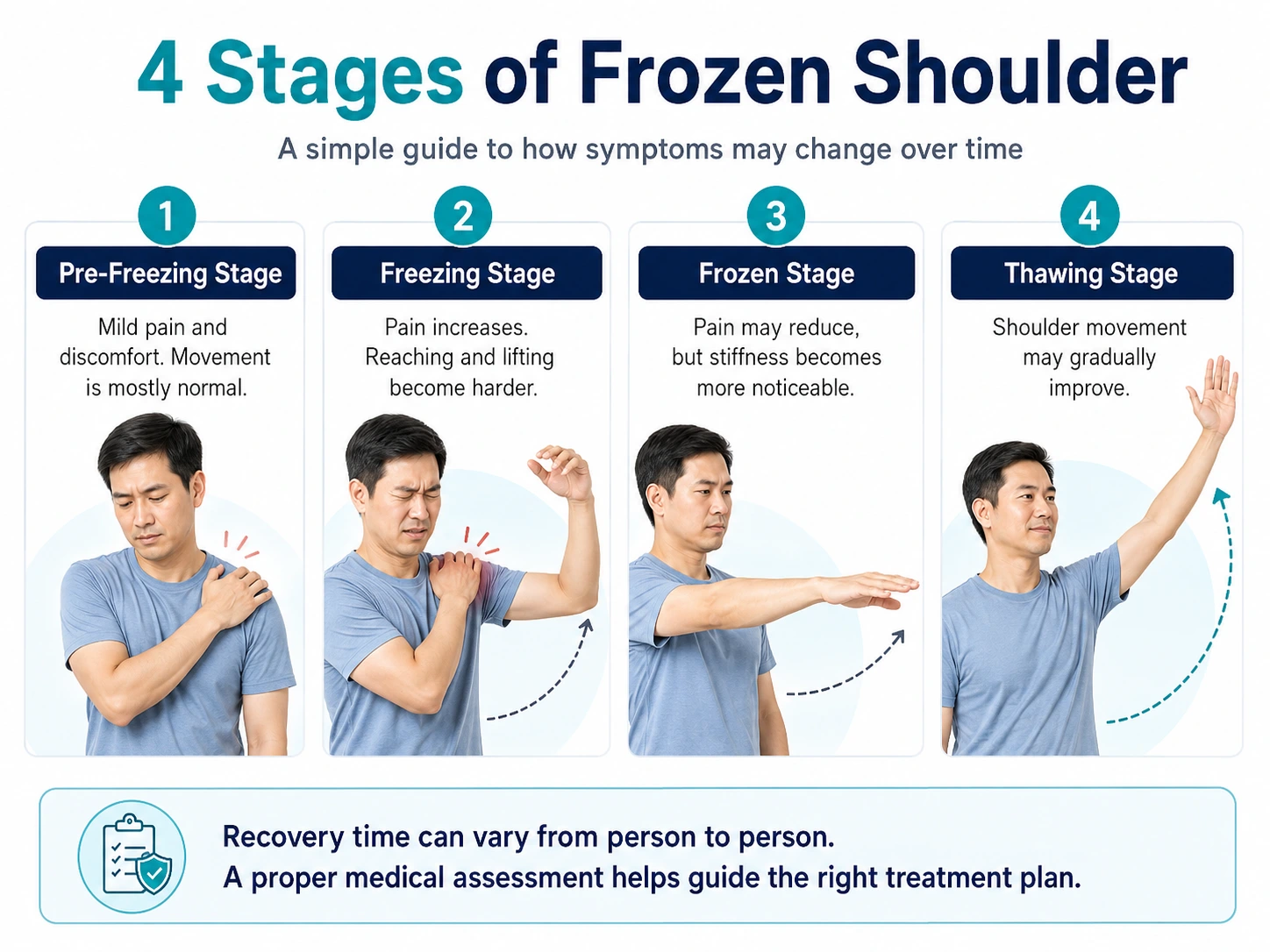
Frozen shoulder can develop gradually. Some patients first notice mild shoulder discomfort, then increasing pain, stiffness and reduced movement over time. The exact pattern can vary from person to person.

1

Pre-Freezing Stage

Mild shoulder discomfort may begin while movement is still mostly normal.

2

Freezing Stage

Pain may increase and reaching or lifting the arm can become harder.

3

Frozen Stage

Pain may reduce for some patients, but stiffness and limited movement become more noticeable.

4

Thawing Stage

Shoulder movement may gradually improve, depending on the condition and treatment plan.

Simple infographic showing the stages of frozen shoulder.

This visual explains how symptoms and shoulder movement may change over time. It is a guide only and does not replace a personal medical assessment.

Why frozen shoulder may happen

Frozen shoulder is commonly linked with tightness and irritation around the shoulder joint capsule. In some patients, stiffness may develop after reduced shoulder movement, pain, injury or other health-related factors.

Capsule tightness

The shoulder joint capsule may become tight and less flexible.

Reduced movement

Avoiding shoulder movement may make stiffness more noticeable.

Common risk factors

Risk factors do not confirm a diagnosis, but they can help patients understand why shoulder stiffness should be assessed when it continues.

Age group

More commonly seen in middle-age and older adults.

Diabetes

Diabetes may be associated with a higher chance of shoulder stiffness.

Recovery time is different for each patient. Treatment decisions should be based on symptoms, shoulder movement, clinical assessment and investigation findings when required.

When to Get Checked

When to See an Orthopaedic Specialist

Mild shoulder discomfort may improve with simple care, but ongoing pain, stiffness or reduced movement should not be ignored. An orthopaedic assessment can help identify the likely cause and suitable next steps.

Pain is not improving

Shoulder pain that continues or keeps returning may need proper assessment.

Sleep is affected

Night pain or discomfort while lying on the affected side should be checked if it continues.

Arm lifting is difficult

Difficulty lifting the arm, reaching overhead or combing hair may suggest movement restriction.

Reaching behind is hard

Trouble reaching behind the back, fastening clothes or washing the back can happen with shoulder stiffness.

Stiffness is getting worse

Increasing tightness or reduced shoulder rotation may need clinical evaluation.

Daily activities are limited

Dressing, driving, work tasks, exercise or carrying items may become harder due to pain and stiffness.

Seek urgent medical attention if shoulder pain follows a major injury, is associated with severe swelling, fever, chest pain, arm weakness, numbness or sudden inability to move the arm.

Assessment and Tests

Assessment & Tests for Frozen Shoulder

Clinical examination comes first. Imaging may be discussed only when the shoulder assessment suggests the need to check bone, capsule, ligament, tendon or other shoulder structures.

Doctor performing clinical shoulder examination for frozen shoulder assessment
Shoulder movement, rotation and stiffness pattern are checked during clinical examination.

Clinical Examination

Shoulder movement, rotation and stiffness pattern are checked first during consultation.

X-ray

Plain radiograph may be done to look for bone pathology or other possible causes of shoulder pain.

Ultrasound

May be discussed if soft tissue structures around the shoulder need to be reviewed.

MRI

MRI may be done to further assess the capsule, ligaments and tendons when clinically required.

Clinical examination is the first step. Imaging is advised only when clinical findings suggest that further shoulder assessment is needed.

Assessment-Based Care

Frozen Shoulder Care Starts With a Check-Up

This page gives general awareness only. The right next step can only be discussed after the doctor checks the shoulder, understands the symptoms and reviews the clinical findings.

Symptoms Are Reviewed

Pain, stiffness, night discomfort and daily activity difficulty are discussed during the clinic consultation.

Shoulder Movement Is Checked

Lifting, rotation and stiffness pattern help the doctor understand how the shoulder is affected.

Next Step Is Discussed

The doctor explains suitable guidance after assessment, based on the patient’s symptoms and shoulder condition.

If Structural Damage Is Found

If there is structural damage such as a torn ligament or tendon, minimally invasive surgical options will be discussed after clinical assessment.

The page explains awareness, not a full treatment plan

Frozen shoulder symptoms can look similar to other shoulder problems. A clinic assessment helps the doctor understand what may be causing the stiffness and what should be discussed next.

Pain pattern Movement check Clinical review Next-step advice

Consult before deciding

The suitable care option should be decided after proper shoulder assessment, not only from online information.

Patient-Focused Shoulder Assessment

Why Choose KMZ for Frozen Shoulder Assessment?

KMZ Orthoman provides orthopaedic consultation for frozen shoulder, shoulder stiffness and limited movement, with guidance based on clinical assessment and each patient’s symptoms.

Shoulder Assessment

Shoulder pain, stiffness, movement restriction and daily activity difficulties are reviewed during consultation.

Clear Explanation

Dr KMZ explains the possible condition and next step in simple words after checking the shoulder.

Orthopaedic Review

Patients can consult for frozen shoulder, shoulder pain, stiffness and limited arm movement concerns.

Next Steps After Assessment

Suitable guidance is discussed after assessment, based on symptoms, shoulder movement and clinical findings.

Patient Feedback

What Patients Say About KMZ Orthoman

Read Google reviews shared by patients about their experience with KMZ Orthoman, orthopaedic consultation and patient care.

Google Reviews
Real Patient Experiences

Feedback shared through Google reviews.

Reviews help patients make an informed decision

Experiences may vary from patient to patient. A consultation is required to discuss shoulder pain, stiffness, frozen shoulder symptoms and suitable next steps.

Patient Education Videos

Frozen Shoulder Education Videos

Watch patient-friendly educational videos about frozen shoulder, shoulder stiffness, movement limitation and treatment guidance. These videos are for general understanding and do not replace a consultation.

Video 01

What Is Frozen Shoulder?

Learn what frozen shoulder means, why the shoulder may become stiff and how movement can become limited over time.

Video 02

Symptoms and Shoulder Stiffness

Understand common symptoms such as shoulder pain, night discomfort, stiffness, arm lifting difficulty and reduced range of movement.

Video 03

Assessment and Tests

Learn how shoulder movement, pain pattern and stiffness may be assessed, and when imaging may be discussed if clinically needed.

Video 04

Treatment and Recovery Guidance

Understand that treatment and recovery guidance may depend on the patient’s symptoms, shoulder movement, stage and clinical findings.

Educational videos are not a diagnosis

These videos are shared for patient education. The suitable assessment and treatment plan depends on symptoms, stiffness, shoulder movement, clinical findings and recovery needs.

Reviewed for Patient Education

This frozen shoulder treatment page has been reviewed by Dr. Kamarulzaman for clarity and patient education. The information is general in nature and does not replace a personal consultation, diagnosis or treatment plan. Treatment decisions should be made after proper clinical assessment.

Frequently Asked Questions

Common Questions About Frozen Shoulder

These answers are for general awareness. A proper shoulder assessment is needed before the doctor can advise the suitable next step.

What is frozen shoulder?

Frozen shoulder, also known as adhesive capsulitis, is a condition that can cause shoulder pain, stiffness and reduced movement. It may make lifting the arm, rotating the shoulder or reaching behind the back difficult.

What are the first signs of frozen shoulder?

Early signs may include shoulder pain, stiffness, difficulty lifting the arm, discomfort when reaching behind the back or pain that affects sleep. Symptoms can start gradually and become more noticeable.

Why does frozen shoulder pain feel worse at night?

Some patients feel more discomfort at night, especially when lying on the affected side or changing sleeping position. If night pain continues, a shoulder assessment can help guide the next step.

Can frozen shoulder make it hard to lift my arm?

Yes. Frozen shoulder can restrict shoulder movement and make daily activities difficult, such as wearing clothes, combing hair, lifting the arm or reaching behind the back.

What causes frozen shoulder?

Frozen shoulder may happen when the shoulder capsule becomes tight and stiff. It can also be associated with reduced movement after injury, surgery or a period of limited shoulder use.

Is frozen shoulder common in people with diabetes?

Frozen shoulder can be more common in some patients with diabetes or certain medical conditions. If shoulder stiffness develops, it is better to get assessed rather than ignoring the symptoms.

When should I see an orthopaedic specialist for shoulder stiffness?

You should consider seeing an orthopaedic specialist if shoulder pain, stiffness, night discomfort or limited movement continues, affects sleep or makes daily activities difficult.

Do I need an X-ray, ultrasound or MRI for frozen shoulder?

Not every patient needs imaging. The doctor may discuss X-ray, ultrasound or MRI only when clinical findings suggest the need to check bone, capsule, ligament, tendon or other shoulder structures.

Can frozen shoulder get better on its own?

Some symptoms may improve over time, but recovery can be slow and different for each patient. If pain or stiffness affects daily life, a clinical assessment can help decide the suitable next step.

Is frozen shoulder treatment available in Kuala Lumpur?

Yes. KMZ Orthoman provides orthopaedic consultation for frozen shoulder, shoulder pain, stiffness and limited movement in Kuala Lumpur. The doctor will assess the shoulder before discussing suitable guidance. Book an appointment here.

Every shoulder condition is different

The suitable next step depends on symptoms, shoulder movement, clinical findings and consultation with the doctor.

Translate »