
Arthroscopic Surgery: Procedure, Uses, Recovery and Risks
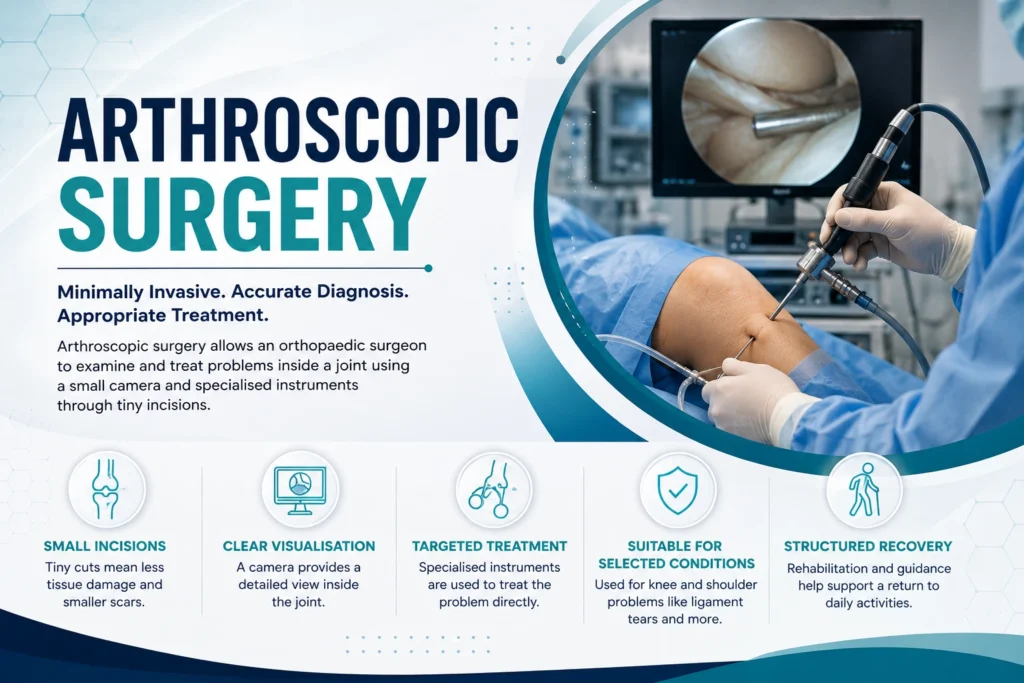
Arthroscopic surgery allows an orthopaedic surgeon to examine and treat selected problems inside a joint through small incisions. The surgeon inserts a thin camera, called an arthroscope, and views the joint on a monitor.
Doctors commonly use this technique for selected knee and shoulder conditions. However, arthroscopy does not suit every patient or every type of joint pain. A doctor must first confirm the diagnosis and consider the available treatment options.
What Is Arthroscopic Surgery and Why Do Doctors Use It?
During arthroscopic surgery, the surgeon places a small camera and light inside the affected joint. The camera shows cartilage, ligaments, tendons and other internal structures.
When treatment is appropriate, the surgeon inserts small surgical instruments through additional openings. The surgeon may then repair, trim or remove selected damaged tissue.
People sometimes call arthroscopy “keyhole surgery” because it uses smaller incisions than open surgery. However, it remains an operation that may require anaesthesia, hospital facilities and rehabilitation.
Which Joint Problems May Need Arthroscopic Assessment?
An orthopaedic specialist may consider arthroscopy when a diagnosed joint problem continues to cause:
- Persistent pain
- Repeated swelling
- Joint locking or catching
- Instability or giving way
- Restricted movement
- Difficulty performing daily activities
However, these symptoms do not automatically mean that a patient needs surgery.
The doctor may first recommend medication, activity changes, physiotherapy, rehabilitation, bracing or injections. Surgery becomes one possible option only after the doctor reviews the diagnosis, symptoms and response to previous treatment.
Knee Problems
Knee arthroscopy may help selected patients with meniscus tears, ligament injuries, loose bone or cartilage fragments and certain cartilage problems.
Surgeons may also use arthroscopic techniques during some ACL reconstructions. Still, not every ligament injury requires surgery. The doctor considers knee stability, associated injuries, activity level and the patient’s recovery goals.
Patients with knee instability or sports-related symptoms can learn more about knee ligament injury or consult a sports injury specialist.
Shoulder Problems
Doctors may use shoulder arthroscopy for selected rotator cuff tears, labral injuries and shoulder instability. The surgeon may repair damaged tissue after confirming the diagnosis and suitability of the procedure.
However, many shoulder conditions respond to non-surgical care. Patients with pain, stiffness and limited shoulder movement can also read about frozen shoulder treatment.
Knee Osteoarthritis
Doctors do not routinely use arthroscopic surgery to treat knee arthritis alone. In selected cases, arthritis may appear with another treatable condition, such as a meniscus tear. The doctor must assess each case individually.
How Does a Specialist Decide Whether Arthroscopy Is Suitable?
The doctor starts with a detailed medical history and physical examination.
During the assessment, the doctor may check:
- Joint movement
- Swelling and tenderness
- Muscle strength
- Joint stability
- Previous treatment results
The doctor may also request X-rays, an MRI or another imaging test when clinically appropriate.
After reviewing the findings, the specialist explains the likely diagnosis and available treatment options. An orthopaedic consultation does not automatically lead to surgery.
The doctor may recommend non-surgical care, arthroscopy, open surgery or continued monitoring based on the patient’s individual condition.
What Happens During Arthroscopic Surgery?
First, the medical team prepares the patient and selects a suitable type of anaesthesia.
The surgeon then:
- Makes small openings near the joint.
- Inserts the arthroscope.
- Views the joint on a monitor.
- Inserts small instruments when treatment is required.
- Completes the planned repair or treatment.
- Closes or covers the incisions.
After the operation, the team monitors the patient in a recovery area. Many arthroscopic procedures take place as day surgery. However, some patients may need to stay overnight, depending on the operation, anaesthesia and medical condition.
What Are the Benefits and Limitations of Arthroscopy?
Arthroscopy gives the surgeon a direct view inside the joint through small incisions. It may also allow the surgeon to treat selected damage during the same procedure.
However, small skin openings do not make every arthroscopic operation minor.
A ligament reconstruction, tendon repair or cartilage procedure may require a structured rehabilitation programme and several months of recovery. Arthroscopy may also fail to correct severe joint damage. In such cases, the patient may need a different procedure.
Patients can learn more about minimally invasive surgery. Still, they should not select a procedure only because it uses smaller incisions. The diagnosis and expected benefit should guide the decision.
How Long Does Recovery After Arthroscopic Surgery Take?
Recovery varies from one patient to another. It depends on:
- The affected joint
- The procedure performed
- The tissue repaired
- The patient’s general health
- Work requirements
- Sports and activity levels
- Participation in rehabilitation
Some patients recover from a minor procedure relatively quickly. However, ligament or tendon repair may require several months. NHS guidance states that full recovery can range from around one week to several months.
After surgery, patients may experience pain, swelling, bruising or stiffness. The medical team may recommend pain relief, elevation, ice, crutches, a brace, a sling or physiotherapy.
Patients should follow their personal recovery plan. They should also avoid comparing their progress with someone who underwent a different procedure.
A patient should return to driving only after regaining safe control of the vehicle and the ability to perform an emergency stop. The surgeon or physiotherapist should guide the return to work, exercise and sport.
What Risks Should Patients Understand Before Surgery?
Every operation carries possible risks.
Possible complications of arthroscopic surgery include:
- Infection
- Bleeding inside the joint
- Blood clots
- Joint stiffness
- Nerve or blood-vessel injury
- Continuing pain or other symptoms
- A need for further treatment
The specific risk depends on the joint, planned procedure and patient’s medical condition. The medical team should explain the relevant risks before the patient gives consent.
Patients should contact their medical team if they develop fever, increasing pain, severe swelling, worsening redness, unusual wound discharge, numbness or tingling.
Chest pain, severe breathing difficulty or another emergency requires urgent medical attention.
Is Arthroscopic Surgery Suitable for Every Patient?
No. Arthroscopic surgery may help selected patients, but it does not suit every joint condition.
The specialist considers:
- The confirmed diagnosis
- Severity and duration of symptoms
- Imaging results
- Joint stability
- Previous treatments
- General health
- Work and sports requirements
- Possible benefits and risks
Patients should not decide on surgery from online information alone. A clinical examination allows the doctor to explain realistic treatment options, limitations and risks.
Arthroscopic Surgery Consultation in Kuala Lumpur and Shah Alam
KMZ Orthoman provides assessment for knee, shoulder, ligament, joint and sports injury concerns.
Patients can consult Dr KMZ at the Kuala Lumpur clinic or Avisena Specialist Hospital in Shah Alam, subject to appointment availability. KMZ Orthopedic Clinic
During the consultation, the doctor examines the affected joint, reviews available imaging and discusses suitable non-surgical or surgical options.
Patients with persistent symptoms can book an orthopaedic appointment for an individual assessment.
Frequently Asked Questions About Arthroscopic Surgery
1. Is arthroscopic surgery a major operation?
Arthroscopy uses small incisions, but it remains a surgical procedure.
It may require anaesthesia, an operating theatre and rehabilitation.
The procedure may involve a simple joint examination or a more complex
ligament, tendon or cartilage repair.
2. Which joints can doctors examine with arthroscopy?
Doctors commonly use arthroscopy for selected knee and shoulder
conditions. They may also use it for certain ankle, elbow, hip and wrist
problems. The suitable approach depends on the diagnosis and available
treatment options.
3. Can arthroscopic surgery treat an ACL injury?
Surgeons may use arthroscopic techniques during ACL reconstruction.
However, not every ACL injury requires surgery. The doctor considers knee
instability, associated injuries, activity requirements and the patient’s
treatment goals.
4. How long does arthroscopic surgery recovery take?
Recovery may range from around one week to several months. A minor
procedure may require less recovery time than ligament or tendon repair.
The surgeon provides guidance based on the affected joint and the
treatment performed.
5. What are the possible risks of arthroscopy?
Possible risks include infection, bleeding, blood clots, stiffness,
nerve or blood-vessel injury and continuing symptoms. The level of risk
depends on the patient’s health, affected joint and planned procedure.
6. Where can I consult about arthroscopic surgery in Kuala Lumpur or Shah Alam?
Patients can arrange an assessment with KMZ Orthoman in Kuala Lumpur or
at Avisena Specialist Hospital in Shah Alam, subject to appointment
availability. The doctor will assess the joint and explain whether
non-surgical care, arthroscopy or another option may be suitable.
Book an orthopaedic appointment
.


Ask a Question or Leave a Comment
Share your feedback or ask a general question about this article.
No comments yet. Be the first to share your feedback or ask a question.