
Facet Joint Related Back Pain
RFA may be considered when persistent localised back pain is thought to arise from structures around the spinal facet joints.
KMZ Orthoman Back Pain Treatment
Dr KMZ provides assessment for patients with persistent back pain, including pain that may arise from the facet joints and selected lumbar disc prolapse. Depending on the source of pain, symptoms, clinical examination and investigation findings, treatment options may include radiofrequency ablation for selected facet-related back pain or percutaneous laser disc decompression (PLDD) for selected contained lumbar disc prolapse.
Understanding Radiofrequency Treatment
Radiofrequency ablation (RFA), also known as radiofrequency denervation, is a minimally invasive procedure that uses controlled radiofrequency energy to target selected nerves involved in transmitting pain from the facet joints of the spine. It may be considered for selected patients with persistent back pain when clinical assessment suggests that facet-related nerves are contributing to the pain.
RFA may be considered when persistent localised back pain is thought to arise from structures around the spinal facet joints.
The procedure targets selected medial branch nerves that carry pain signals from the facet joints rather than treating the entire spine.
A specialised needle or probe is positioned near the selected nerve so controlled radiofrequency energy can be applied without the larger incision associated with open surgery.
RFA and disc treatment are different procedures: radiofrequency ablation targets selected pain-transmitting nerves. It does not decompress a prolapsed disc. Percutaneous laser disc decompression (PLDD) for selected disc prolapse is explained in the next section.
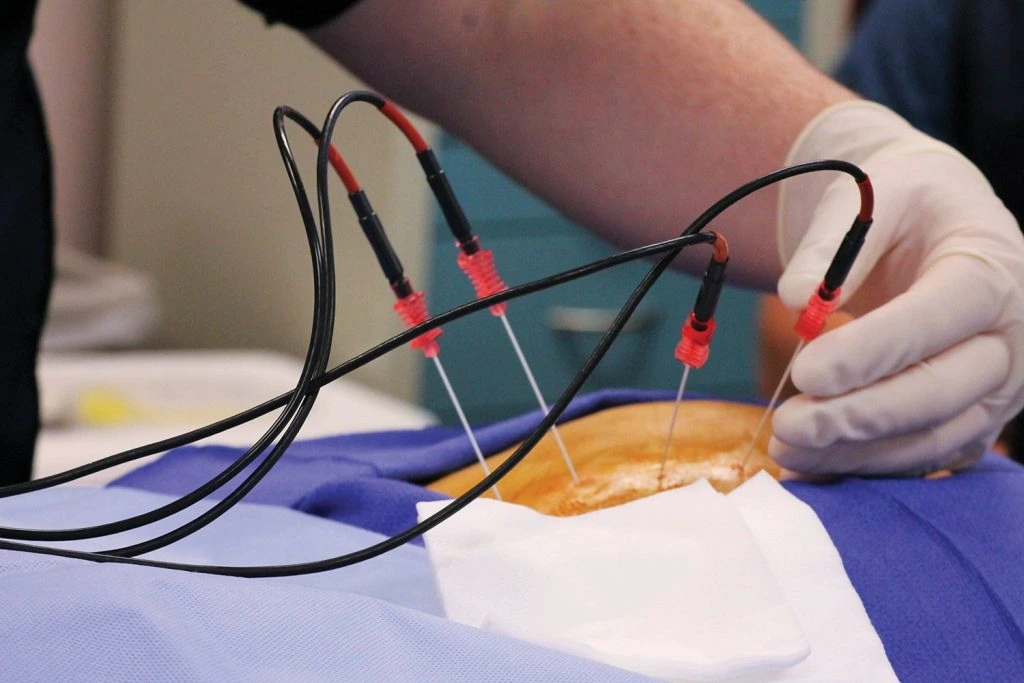
Lumbar radiofrequency ablation: specialised probes are positioned near selected pain-transmitting nerves so controlled radiofrequency energy can be applied to the targeted area.
Laser Disc Treatment
Percutaneous laser disc decompression (PLDD) is a minimally invasive procedure used for selected contained lumbar disc prolapse. A needle is guided into the affected disc and a thin optical fibre delivers laser energy to remove a small amount of disc material, with the aim of reducing pressure within the disc and relieving pressure on nearby nerve structures.
PLDD is intended for selected lumbar disc prolapse where the disc remains contained rather than when disc material has fully extruded through the outer disc layer.
A spinal needle is introduced through the skin and carefully guided into the affected lumbar disc rather than using a larger open surgical incision.
A thin optical fibre is passed through the needle and controlled laser energy is delivered into the central part of the affected disc.
Laser energy vaporises a small amount of the nucleus pulposus. This is intended to reduce pressure within the contained prolapsed disc.
Decompressing the affected disc may help reduce irritation or pressure on nearby nerve structures that can contribute to back pain or leg symptoms such as sciatica.
PLDD is performed through a needle-based approach and may be considered for carefully selected patients after symptoms, examination and imaging findings have been reviewed.
PLDD is suitable only for selected disc problems. Assessment and imaging are needed to determine whether the lumbar disc prolapse is contained and whether laser disc decompression or another treatment approach is more appropriate.
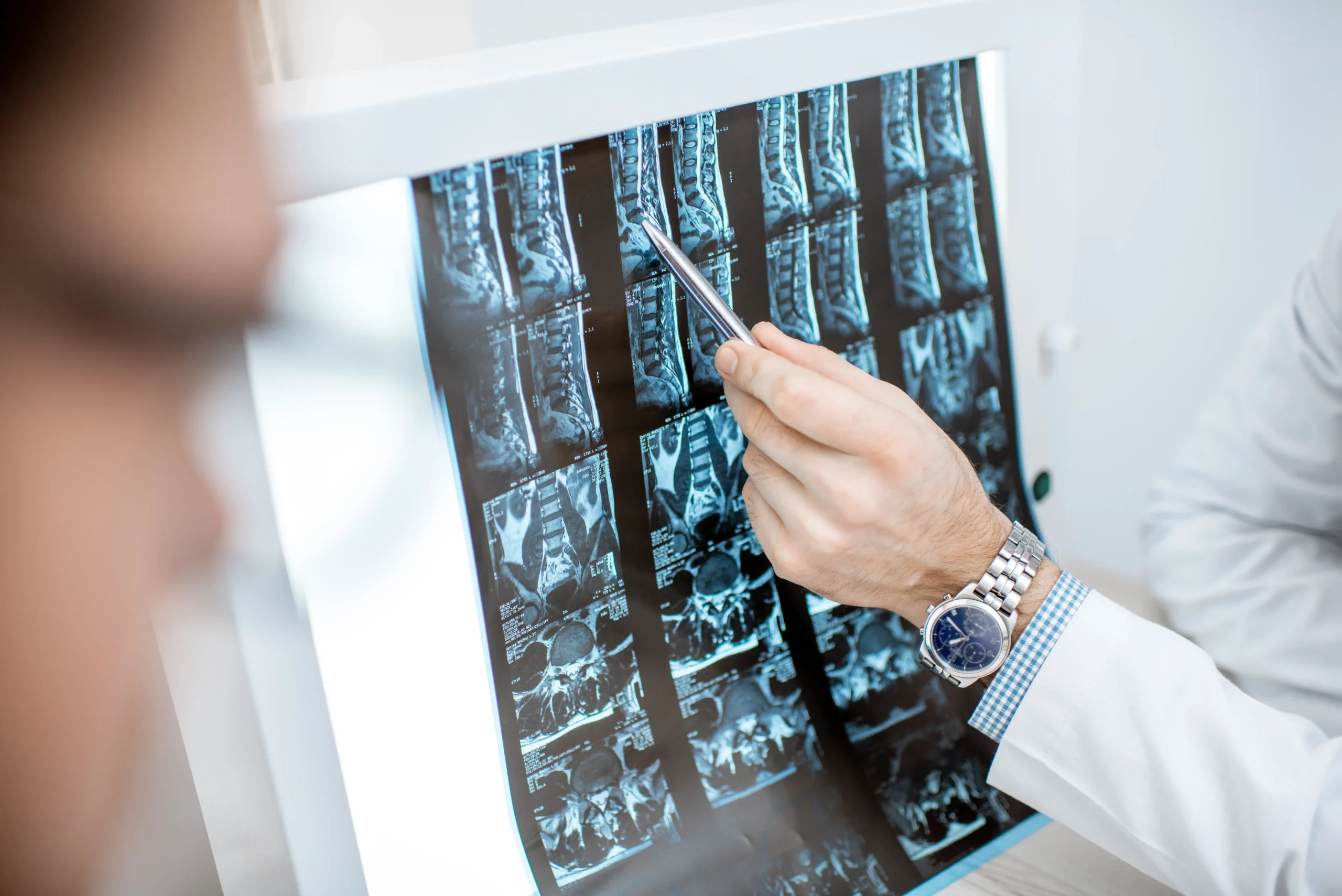
Lumbar spine assessment: MRI and other investigation findings may be reviewed when evaluating disc prolapse and determining whether PLDD or another treatment approach may be appropriate.
From Assessment to Treatment
Persistent back pain can arise from different structures in the spine, so treatment begins by identifying the likely source of symptoms. Dr KMZ reviews the pain pattern, clinical findings, previous treatment and relevant investigations before determining whether radiofrequency ablation, percutaneous laser disc decompression (PLDD) or another treatment approach may be suitable.
The assessment begins by discussing where the pain is felt, how long it has been present, whether symptoms travel into the leg, what makes them worse and how they affect daily movement, work or activity.
The lower back is assessed together with movement, tenderness and relevant neurological findings. This helps distinguish possible facet-related pain from symptoms that may be associated with a lumbar disc or nerve involvement.
Relevant imaging may be reviewed when disc prolapse is suspected. For PLDD, imaging findings help determine whether a disc prolapse is contained and whether a needle-based laser decompression approach may be suitable.
For selected facet-related chronic back pain, radiofrequency ablation may be considered after appropriate diagnostic assessment, including a medial branch block. For selected contained lumbar disc prolapse, PLDD may be considered after the clinical and imaging findings have been reviewed.
Treatment depends on the source of pain: RFA targets selected pain-transmitting nerves associated with facet-related back pain, while PLDD is a disc decompression procedure for selected contained lumbar disc prolapse.
Patient Education Videos
Educational videos about radiofrequency ablation, knee pain, treatment planning and recovery will be added here to help patients better understand the procedure and care process.
A patient-friendly overview of how radiofrequency ablation is used as a minimally invasive pain-management procedure.
Learn how controlled radiofrequency energy is applied near selected nerves involved in transmitting pain signals.
An educational overview of why radiofrequency ablation may be considered for selected patients with persistent knee pain.
Learn about the general assessment, treatment planning and procedural steps involved in radiofrequency ablation.
Patient education about general aftercare, follow-up and what may happen after a radiofrequency ablation procedure.
Educational information only: Videos added to this section are intended to provide general patient education and do not replace an individual consultation, examination, diagnosis or personalised treatment recommendation.
Patient-Focused Back Pain Care
Dr KMZ provides individual assessment for persistent back pain to identify the likely source of symptoms and determine whether radiofrequency ablation, percutaneous laser disc decompression (PLDD) or another treatment approach may be appropriate.
Pain location, symptom pattern, movement, leg symptoms, neurological findings, previous treatment and relevant investigations are reviewed before treatment is discussed.
For selected persistent localised back pain, the likely facet-related pain source and response to appropriate diagnostic assessment are considered before radiofrequency ablation is planned.
Clinical findings and lumbar imaging are reviewed to determine whether a selected contained disc prolapse may be suitable for percutaneous laser disc decompression.
RFA, PLDD, non-surgical management or another treatment approach may be discussed according to the source of pain, examination, imaging and individual treatment needs.
Patient Feedback
Read feedback shared by patients on Google about their experience with KMZ Orthoman and orthopaedic care.
Feedback shared through Google reviews.
Posted on Google Norainidah JayusJuly 8, 2026Trustindex verifies that the original source of the review is Google. Saya sangat berpuashati dengan perkhidmatan Dr KMZ, Doktor pakar Orthopediks sepanjang Saya menerima rawatan patah tulang di hospital PUSRAWI. Sekarang tulang Saya dah bercantum semula. Alhamdulillah. Terima kasih Dr KMZ 👍Posted on Google Ali AbdJuly 5, 2026Trustindex verifies that the original source of the review is Google. Alhamdulillah. My wife underwent surgery for a slipped disc. Before the operation, the doctor explained the procedure in detail, including the risks and the benefits. Now, three months after the surgery, her condition has improved significantly. There have been many positive changes compared to before the operation, and we are truly grateful for her recovery. I highly recommend anyone who needs advice or has questions about slipped disc treatment or surgery to reach out with Dr KMZPosted on Google Muhamed Azhar Abdul Alim SidiqueJune 23, 2026Trustindex verifies that the original source of the review is Google. We had the pleasure of consulting Dr. KMZ yesterday, and the experience was exceptional from start to finish. Dr. KMZ was professional, knowledgeable, and took the time to listen carefully to our concerns. He explained the diagnosis and treatment options clearly and patiently, ensuring that we fully understood the condition and the next steps. We left feeling confident that we were in capable hands. Thank you, Dr. KMZ, for the excellent care and outstanding consultation. Highly recommended to anyone seeking an orthopedic specialist.Posted on Google isyahnaz 5June 11, 2026Trustindex verifies that the original source of the review is Google. 2 ank sy refer dgn Dr KMZ. Servis terbaik mantap dr klinik nie.. smoga lebih ramai refer dgn Dr nie sbb terbaek👍🏻👍🏻👍🏻👍🏻👍🏻Posted on Google Nur Hidayah harisanJune 11, 2026Trustindex verifies that the original source of the review is Google. Thank you, Dr. Kamarulzaman & Puan Sazlina. All went well from start to finish. The doctor and the nurse were both wonderful and very professional.Posted on Google ConradJune 9, 2026Trustindex verifies that the original source of the review is Google. Fantastic doctorPosted on Google NORHAYATI BINTI MUHAMAT (MAIWP)May 25, 2026Trustindex verifies that the original source of the review is Google. DR KAMARULZAMAN AMAT PROFESIONAL DALAM MELAYAN PESAKIT DAN MELAYAN TUGAS,MESRA PESAKIT DAN MENERANGKAN KESIHATAN DENGAN JELAS SERTA MUDAH DIFAHAMI
Patient experiences can differ. A consultation allows your symptoms, diagnosis and suitable treatment options to be discussed individually.
Frequently Asked Questions
Find answers about radiofrequency ablation for persistent back pain, facet joint pain, medial branch blocks, lumbar disc prolapse, sciatica and percutaneous laser disc decompression (PLDD) in Kuala Lumpur.
Radiofrequency ablation (RFA), also called radiofrequency denervation, is a minimally invasive treatment for selected chronic back pain. A specialised probe delivers controlled radiofrequency energy near selected nerves that transmit pain from structures around the spinal facet joints, reducing their ability to send pain signals.
RFA may be considered for selected people with chronic, localised back pain when the likely source is thought to come from structures supplied by the medial branch nerves, which carry pain signals from the facet joints. It is not a treatment for every cause of back pain.
A medial branch block is a diagnostic injection of local anaesthetic around selected medial branch nerves. The response helps determine whether these nerves are likely to be carrying the patient's back pain and whether radiofrequency denervation may be appropriate.
The duration of pain relief varies from person to person. Radiofrequency treatment affects the targeted nerve rather than permanently removing it, and the nerve can gradually recover over time. The response and duration of benefit should therefore be reviewed individually after treatment.
Local anaesthetic and appropriate comfort measures may be used during radiofrequency ablation. Some people experience pressure or discomfort during the procedure and temporary soreness afterwards. Because RFA is performed through a needle or probe, recovery is generally less extensive than recovery from open surgery, although individual recovery time varies.
Percutaneous laser disc decompression (PLDD) is a minimally invasive procedure for selected contained lumbar disc prolapse. A spinal needle is guided into the affected disc and a thin optical fibre delivers laser energy to vaporise a small amount of the nucleus pulposus, with the aim of reducing pressure within the disc.
PLDD may be considered for carefully selected patients whose symptoms and imaging show a contained lumbar disc prolapse. It is not suitable when disc material has fully extruded through the outer disc layer, and treatment selection also depends on symptoms, neurological findings and previous treatment.
A lumbar disc prolapse can irritate or compress a nearby nerve root and cause leg pain or numbness commonly described as sciatica. PLDD may be considered when the symptomatic disc prolapse is contained and the clinical and imaging findings indicate that disc decompression may be appropriate.
RFA and PLDD treat different potential sources of back pain. Radiofrequency ablation targets selected pain-transmitting nerves associated with facet-related back pain. PLDD acts inside a selected contained lumbar disc to reduce disc pressure. Assessment is needed to determine which, if either, matches the cause of a patient's symptoms.
The cost of radiofrequency ablation or PLDD in Kuala Lumpur varies according to the diagnosis, consultation and assessment, diagnostic procedures, imaging, treatment technique, hospital or facility charges and follow-up requirements. An individual estimate can be discussed after the condition and suitable treatment approach have been assessed.